
Strategic marketing has always been a privilege.
Big companies have teams, agencies, and analysts helping them decide what to do next. Small businesses face the same decisions with none of that help. DigiPhi is the support they've never had.
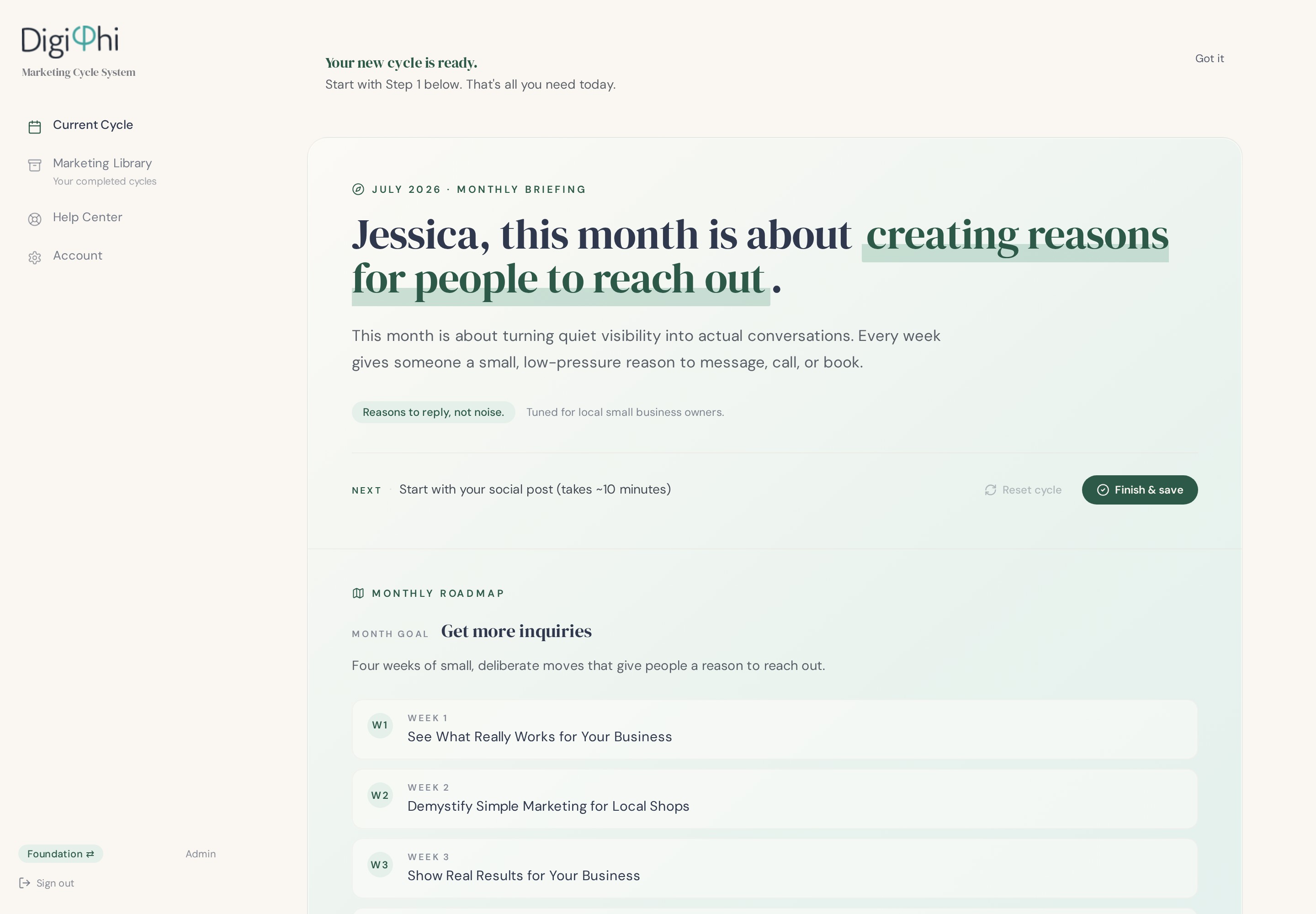
Small businesses are expected to market like enterprises. They make the decisions alone.
Every month, a business owner has to answer the same strategic questions. What should we promote? Where should we invest? What should we say? Which channel matters most? What actually worked last month?
Enterprise companies answer those questions with marketing leaders, analysts, agencies, and historical data. Small businesses answer them between customers, after closing, or late at night—without a team, without a system, and without anything that remembers what happened last month.
The result isn't a lack of effort. It's a lack of strategic infrastructure.
The monthly reality
The owner
Where do I start?
The same strategic decisions return every month. Nothing connects one month to the next.
The tools owners have today
help them execute, not decide.
The last decade gave small businesses production, distribution, and measurement. None of it answers the question every owner still asks at the start of the month: what should we actually do?
That's the space DigiPhi was built for.
AI writers
Write anything you ask for.
They can produce a caption in seconds. They can't tell an owner what this business should say this month, or why it matters.
Scheduling tools
Post anywhere on any day.
They move content to a calendar. They don't know which channel matters right now, or whether last month actually worked.
Templates & courses
Teach a framework.
Frameworks are useful in a classroom. They aren't a plan for what this business should do next Tuesday.
Analytics
Report what already happened.
Dashboards hand the owner more numbers. They don't turn those numbers into a decision.
Three eras of tools.
Still no one helping owners decide.
Small business marketing has cycled through agencies, dashboards, and AI writers. Each era added capability. None of them added strategic support — a system that actually owns the monthly decision. That's the category DigiPhi is building.
Chapter 1
2000s
Hire a local agency.
Marketing meant retainers, print ads, and yellow pages. Strategy was something the owner outsourced.
Chapter 2
2010s
Manage dozens of tools.
Every channel arrived with its own dashboard. Owners became integrators of software they never asked for.
Chapter 3
2020s
Generate endless content with AI.
Production became effectively free. More posts didn't produce more customers, and it didn't produce more clarity either.
Chapter 4
Tomorrow
A system that thinks with the business.
Not another tool the owner has to run. Infrastructure that understands the business, learns each month, and answers the question the last three eras never did: what should we do next?
This is DigiPhi
DigiPhi is a marketing
operating system.
It decides the month with the owner. It sets the strategy, guides the week, and remembers what worked — so every decision builds on the last one instead of starting over.
Not an agency
The owner keeps control, cost, and cadence.
Not another AI writer
It builds the plan first — content comes second.
Not another scheduler
Strategy, execution, and learning in one system.
Not a marketing course
It does the thinking with the business, every month.
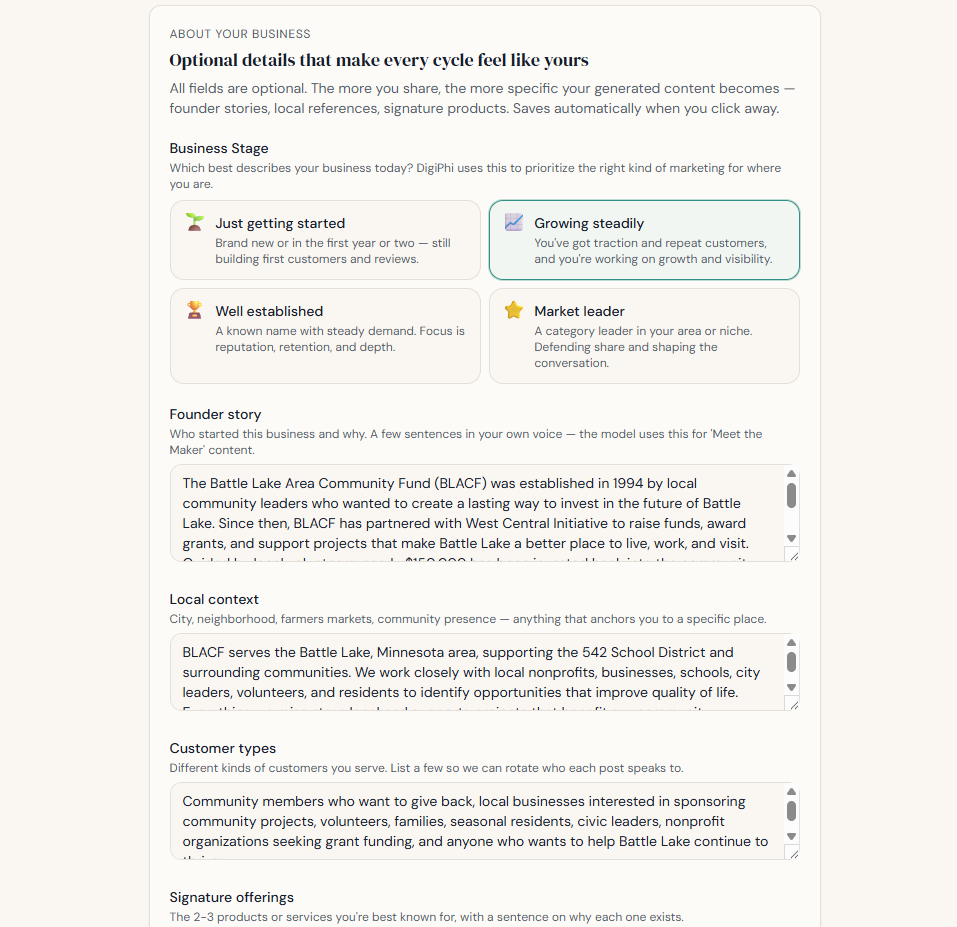
A rhythm the owner
can actually keep.
One decision a month. A few small moves a week. Every cycle leaves the business a little stronger than the one before.
Step 01
Business Profile
The owner shares their business context in minutes.
Step 02
Business Identity
DigiPhi builds a working understanding of the brand.
Step 03
Monthly Strategy
A focused plan for the month ahead, tied to real goals.
Step 04
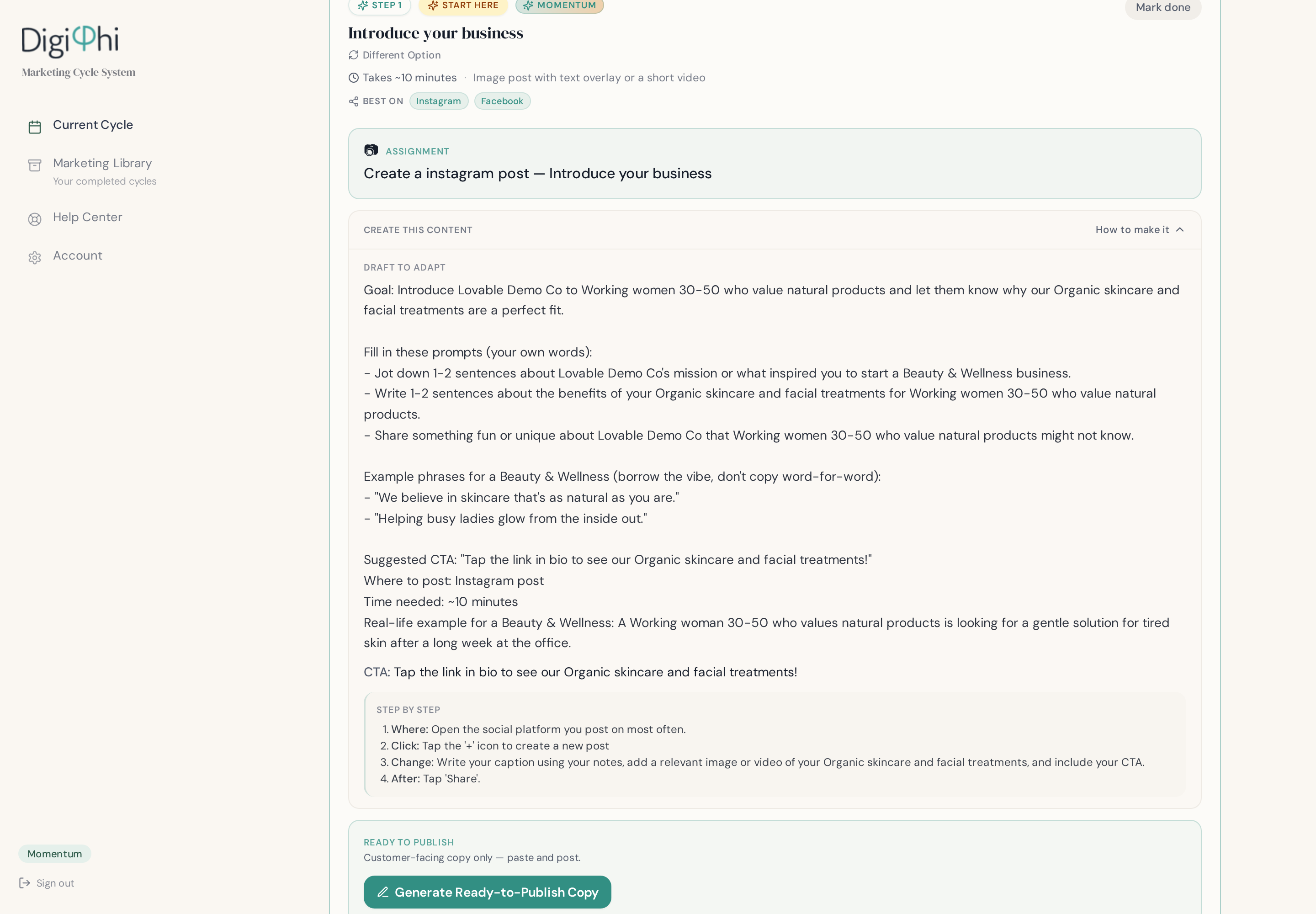
Weekly Assignments
Small, doable cards — never a wall of tasks.
Step 05
Business Memory
DigiPhi remembers what worked, what stalled, what to try.
Step 06
Smarter Next Month
Every cycle sharpens the plan for the one after.
Strategy begins with knowing the business.
Before DigiPhi recommends a single move, it builds a working understanding of the business — its voice, audience, offer, and the place it operates in. Nothing generic. Nothing borrowed.
Identity is the ground every monthly decision is made on.
Founder Story
Brand Voice
Goals
Audience
Offer
Industry
Local Context
Differentiators
The business itself
becomes the training data.
Every plan, every completed month, every skipped card, every outcome is remembered — and shapes the next recommendation. A year in, DigiPhi is reasoning from a year of this business, not from a generic model of somebody else's.
Generic AI starts from zero on every prompt. DigiPhi starts from everything this business has already done — a private memory no competitor can copy or reset.
The compounding loop
- 1
Business Identity
- 2
Strategy
- 3
Execution
- 4
Behavior
- 5
Learning
- 6
Better recommendations
Repeat every month. Each cycle sharpens the next.
Six sources of knowledge behind every recommendation.
Behind the calm interface is a knowledge graph. Six layers of business intelligence reason together each time DigiPhi answers the monthly question. No layer decides on its own.
Output
One recommendation
for this business.
Business Identity
Who this business is.
Business Memory
What this business has done.
Industry Intelligence
How this sector moves.
Decision Engine
What matters most, right now.
Monthly Learning
What last month taught us.
Strategy Generation
The plan the owner opens.
One plan. One month.
One clear next step.
Every surface removes a decision instead of adding one.
Dashboard
Where the month begins.
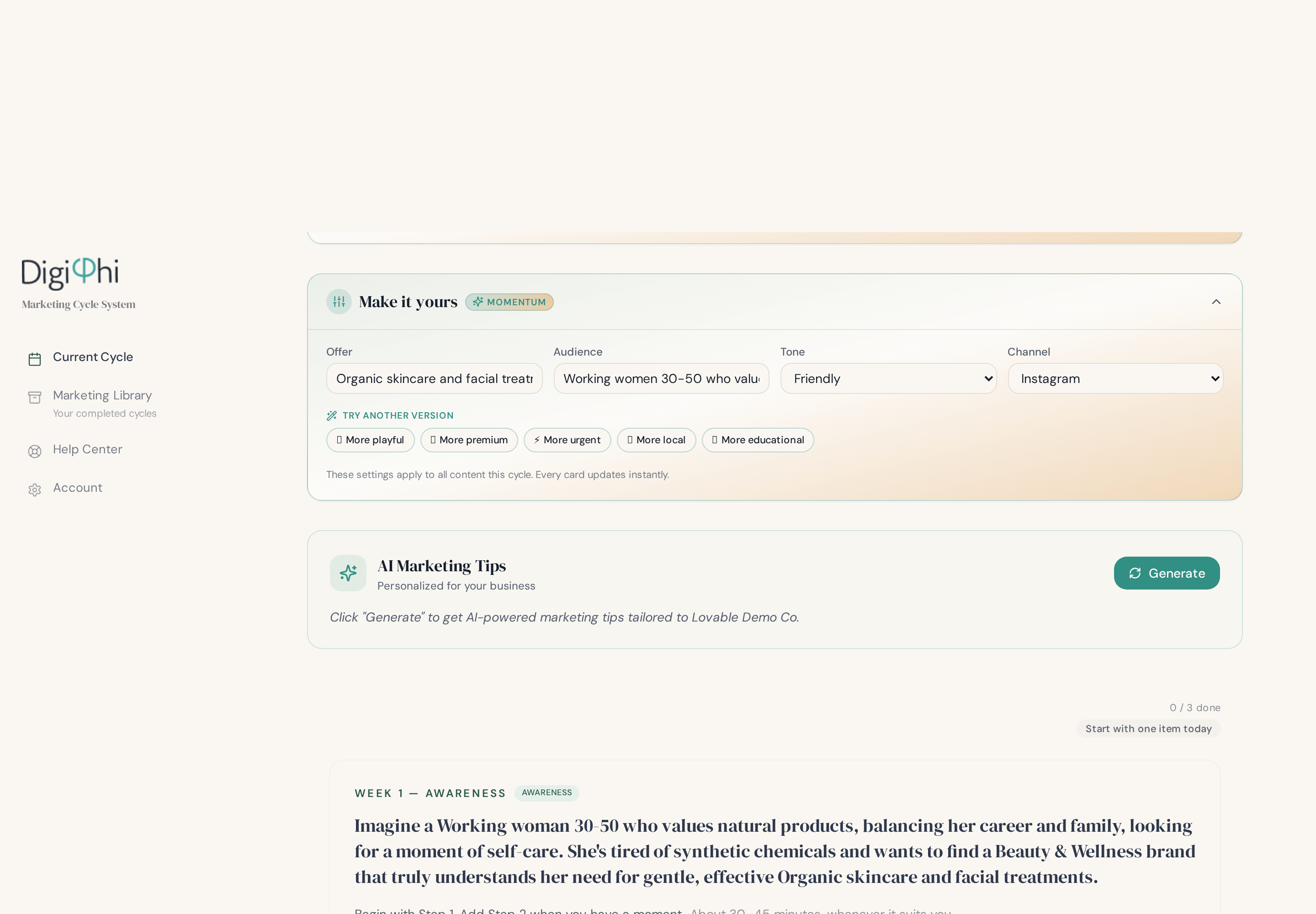
Monthly Briefing
One strategy, in one read.
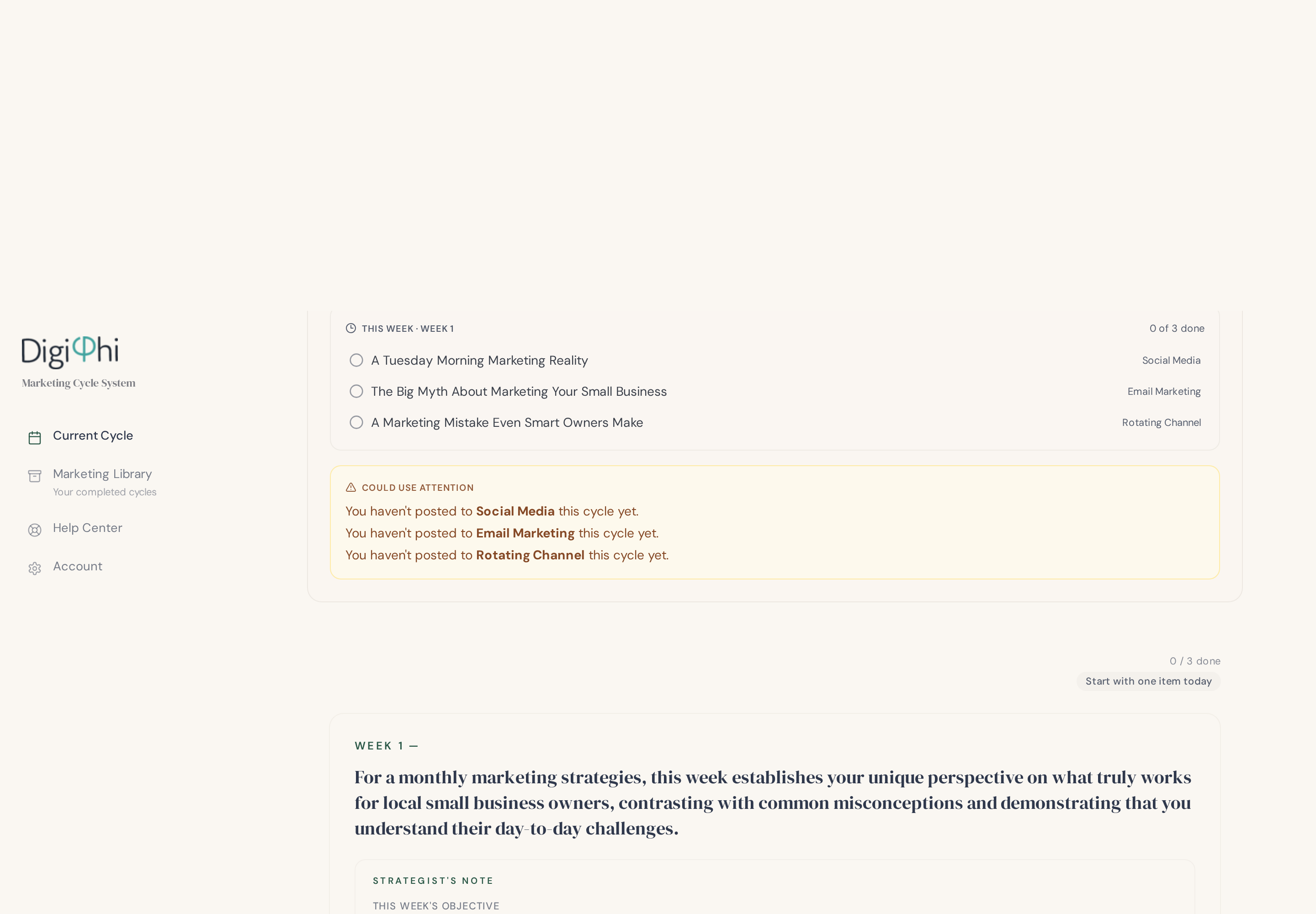
Weekly Cards
Small assignments, real momentum.
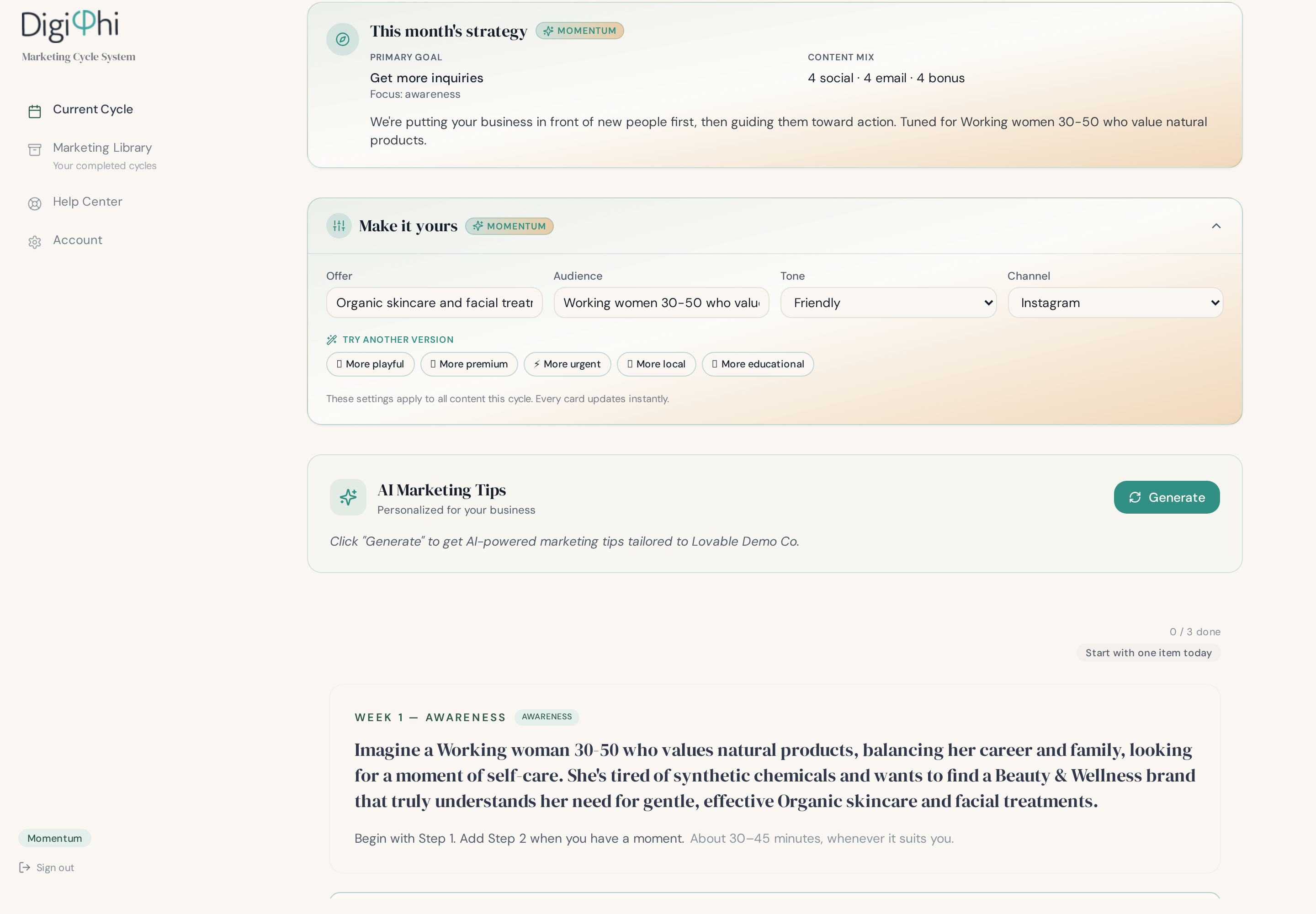
Strategy Review
See the reasoning, not just the plan.
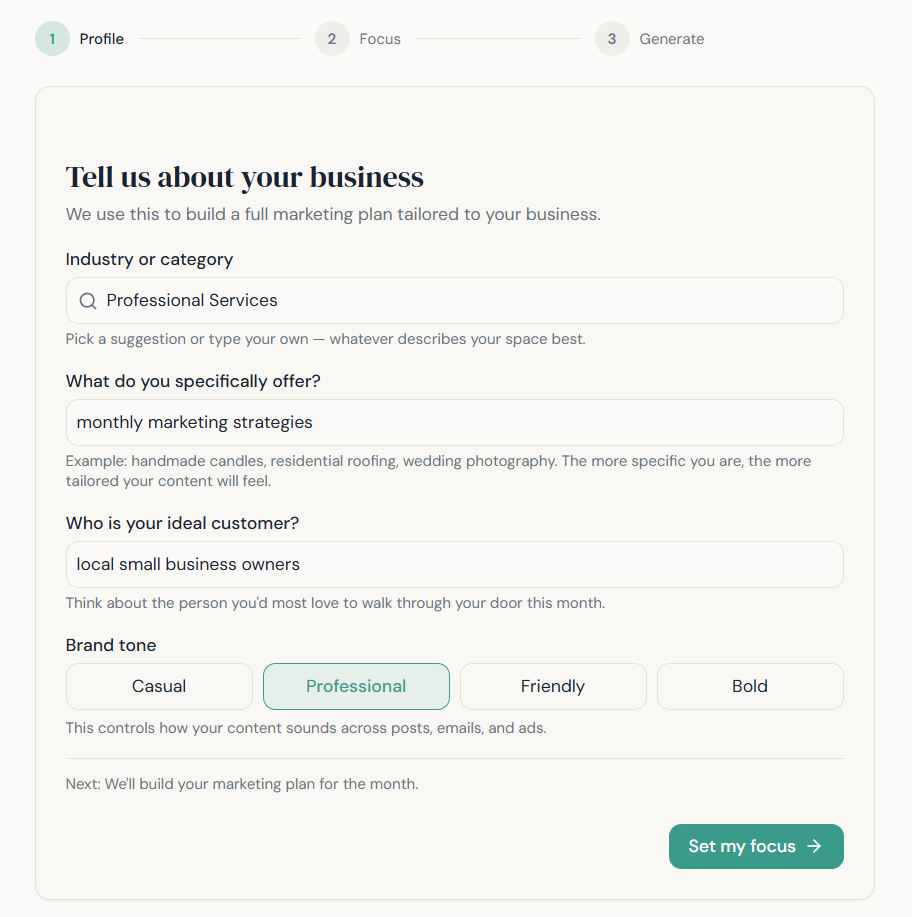
Business Profile
Identity that gets sharper each month.
Admin Intelligence
System-level oversight.
Not a better tool.
A different category.
Every existing category owns a piece of the work — writing, posting, teaching, reporting. None of them own the monthly decision itself, at a price a small business can afford.
| Category | Understands the business | Builds a monthly strategy | Learns over time | Guides weekly execution | Adapts recommendations | Affordable for small businesses |
|---|---|---|---|---|---|---|
| Traditional agencies | ||||||
| AI writing tools | ||||||
| Scheduling platforms | ||||||
| Marketing courses | ||||||
| DigiPhi |
From a plan the owner follows
to a director they work with.
Each stage widens what strategic marketing infrastructure can do, and how many businesses it can reach.
Stage 1
TodayThe Platform
A working operating system: business identity, monthly strategy, weekly execution, and business memory in one calm surface.
Stage 2
DeepeningThe Intelligence
Reasoning that reaches the strategic depth of a senior marketer — across identity, industry, and behavior.
Stage 3
AheadThe Learning
Outcomes and benchmarks fold back into every business's memory, so recommendations get measurably sharper each cycle.
Stage 4
AheadThe Reach
Delivered through the institutions that already serve small business — extending strategic infrastructure to whole regions.
Stage 5
The horizonThe Director
A resident marketing director for every business — the version of DigiPhi every prior stage was quietly building toward.
Every completed month
is a competitive advantage.
The business itself becomes the training data. Each month folds back into a private memory of what this business tried, what worked, and what didn't — a record no one else can replicate.
A year in, DigiPhi isn't more useful because the model changed. It's more useful because it now knows this business better than any outsider ever could.
Generic AI
Starts from zero every prompt. Confident answers with no context about the business asking.
DigiPhi
Starts from a business that already knows itself. Every recommendation stands on months of context, outcomes, and pattern.
Business Memory over time
Compounding advantage
Month 1
Baseline
Identity + industry patterns.
Month 3
Rhythm
Behavior + outcomes begin to shape briefings.
Month 6
Judgment
Recommendations reflect what worked for this business.
Month 12
Advantage
A strategic memory no competitor can copy.

Jessica
MacDonald.
Jessica is the founder of Digital Philosophies. She built DigiPhi after years of watching small business owners make the same marketing decisions her enterprise clients had entire teams to help them make. Her background sits at the intersection of enterprise fintech marketing, go-to-market strategy, and applied AI.
DigiPhi is the product she wished existed for every owner she has worked alongside.
Small business owners deserve the same strategic support big companies pay agencies for — delivered in a way that fits the week they actually have.
Strategic marketing, no longer a privilege.
For most of modern history, strategic marketing has been reserved for the businesses that could afford it. Everyone else has been asked to compete anyway.
The businesses this changes are the ones that hold neighborhoods together — the studios, the corner stores, the family shops, the first-time founders. When they last longer, the streets around them do too.
DigiPhi makes strategic clarity accessible for every business.
hello@digitalphilosophies.com
End of pitch book
Thank you for reading.